Brahma
Bhagavad GitaBrahma occupies a crucial but carefully bounded position in the Bhagavad Gita's cosmology. He is the mighty womb from which embodied beings emerge, the cosmic figure associated with creation, and the ruler of the highest created realm; yet Brahma is not the final reality. Krishna presents himself as the source, support, and transcendence of Brahma, so that the doctrine both honors Brahma's immense creative function and places that function within a larger order directed toward Brahman and liberation.
Cosmic Identity and Generative Function
Brahma is defined most directly through the imagery of generation. Krishna declares that Brahma is a mighty womb and that he places the living germ there; from this union the birth of all beings takes place. Every bodily form born in every womb therefore has Brahma as its great matrix, while Krishna is described as the seed-imparting Father. Brahma's significance lies in this dual image of receptivity and production: he is the cosmic ground in which life takes form, but the originating seed and governing power come from beyond him.
This account makes Brahma a principle of universal embodiment rather than merely a deity associated with one isolated act. The body, the senses, the mind, the elements, and the changing qualities of nature belong to the field of manifested existence, and Brahma's womb is the immense cosmic setting in which such forms arise. Creation is consequently not presented as a single event detached from moral and spiritual law. Beings enter bodies under the conditions produced by nature and by their relation to the three qualities, while the larger process remains contained within Krishna's sovereignty.
Brahma in the Hierarchy of the Divine
The text repeatedly distinguishes Brahma from the Supreme reality. Krishna identifies himself as the source of all things and as the origin even of the gods and the great seers. In his discourse on the highest knowledge, he describes himself as the father, mother, creator, grandsire, refuge, support, and imperishable seed of the universe. Brahma therefore belongs to the order of creation that Krishna sustains and transcends, rather than standing as an independent beginning outside that order.
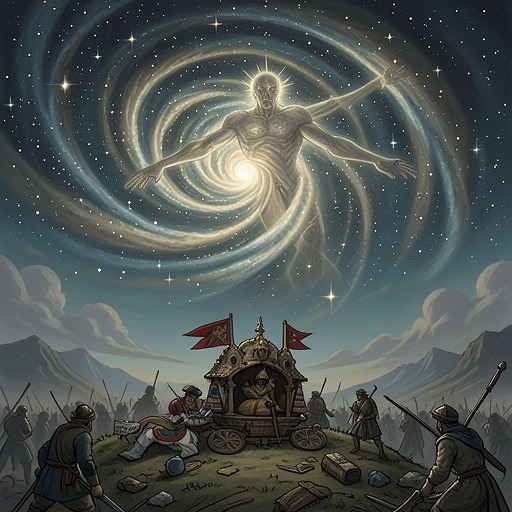
The same hierarchy appears when Arjuna beholds Krishna's universal form. Brahma is seen seated upon his lotus seat within the revealed body of the God of gods, alongside the gods, seers, and other hosts of beings. This vision does not erase Brahma's dignity; instead, it relocates him inside a totality whose innumerable forms, origins, and powers are gathered into Krishna's cosmic body. Brahma is thus an exalted participant in the universe, but the universal form discloses that even the creator is encompassed by a greater divine reality.
The distinction becomes explicit in the teaching concerning the field and its knower. The object of knowledge is the Supreme Brahma, without beginning, neither simply existent nor non-existent, with hands, feet, eyes, heads, and faces everywhere. This Brahma is the all-pervading, subtle, indestructible reality that sustains, absorbs, and creates all beings and dwells in their hearts. The name Brahma therefore operates on two connected levels in the text: Brahma as the mighty creator and womb of embodied life, and Brahman as the supreme, beginningless reality toward which knowledge ultimately leads. Confusing these levels would obscure the Gita's central movement from created forms to the imperishable ground of existence.
Creation, Dissolution, and Cosmic Time
Brahma's realm and creative activity are governed by immense cycles. Krishna teaches that all worlds, from Brahmaloka downward, pass through repeated birth and rebirth. At the coming of Brahma's day, manifested things spring forth from the unmanifest; when Brahma's night arrives, they disappear again into that same unmanifest condition. The entire assemblage of creatures comes forth repeatedly and dissolves repeatedly, compelled by the force of action and the conditions of nature.
The scale of this process is deliberately vast: a day of Brahma ends after a thousand Yugas, and a night of Brahma also extends through a thousand Yugas. Such duration gives Brahma an almost unimaginable cosmic authority, yet it also reveals the limits of that authority. Even the highest created sphere remains within cyclic time. The worlds do not escape recurrence merely because they are elevated, and Brahma's cosmic day and night remain part of the rhythm of manifestation and withdrawal.
Beyond the unmanifest that receives beings during cosmic dissolution, Krishna describes another unmanifest and eternal entity that is not destroyed when all other entities are destroyed. This is the highest goal, the supreme seat from which there is no return. Brahma's cycle therefore serves as a contrast that clarifies liberation: creation may be renewed, and the worlds may endure across vast cosmic intervals, but only attainment of the Supreme ends rebirth. Brahma marks the summit of created cosmology, not the termination of spiritual striving.
Brahma, Knowledge, and Sacrificial Order
Brahma is also connected with the transmission and structure of sacred knowledge. Krishna states that the imperishable system of devotion was first declared to Vivasvat, then passed to Manu, and then communicated to Ikshaku, through whom royal sages came to know it. Although Brahma is not named as the first speaker in this particular succession, the teaching places sacred order within a lineage extending through primordial and royal figures rather than treating it as an isolated revelation. The loss and renewal of that devotion show how cosmic and social order can decay and require restoration.
The sacrificial order is similarly placed within a chain reaching beyond human preference. Work proceeds from the Vedas, and the Vedas proceed from the imperishable source; the all-pervading Supreme Being is therefore installed in sacrifice. Sacrifice, work, food, and the continued life of creatures form a revolving order, and a person who refuses to participate in that wheel is said to live vainly. Brahma's creative womb and the sacrificial system belong to the same broad vision: life is sustained through an ordered relation among cosmic source, duty, offering, and consequence.
The Gita nevertheless refuses to make ritual performance the final measure of spiritual attainment. The sacrifice of knowledge is declared superior to sacrifices aimed at the fruits of action, because all action is comprehended in knowledge. Through knowledge, a person sees creatures first in the self and then in Krishna, crosses transgression as though on a raft, and burns actions like fuel consumed by fire. Brahma's cosmic and sacrificial associations thus point toward a higher transformation in which action is understood, purified, and released from attachment to its fruits.
Brahma and the Path Beyond Creation
The relation between Brahma and liberation is stated with particular force in the Gita's account of devotion and final knowledge. Krishna is described as the support of Brahma, immortality, indestructibility, eternal piety, and unbroken felicity. Exclusive devotion therefore does not merely lead to a superior place within the created universe; it makes the devotee fit to enter the nature of Brahma in the highest spiritual sense, while Krishna remains the ground in which even that reality is supported.
This teaching also explains why the text places such emphasis on abandoning attachment rather than abandoning prescribed action. Sacrifice, gifts, and penance should still be performed, but without attachment and without clinging to their fruits. Since an embodied person cannot absolutely abandon action, the true renouncer is the one who abandons the fruit of action. By performing the duty arising from one's own nature, worshipping the source of all beings, and relinquishing egoistic ownership, a person moves from participation in the cosmic order toward freedom from its binding consequences.
Brahma's narrative role is therefore structurally paradoxical. He represents the grandeur of creation, the womb of all bodily forms, the height of the ordered universe, and the vast time-span of cosmic renewal. At the same time, his realm remains within birth and dissolution, while the Supreme Brahman is beyond both. Brahma gives the cosmos its generative scale, but the Gita uses that scale to teach that no created height, however magnificent, equals the final freedom found through knowledge, devotion, and release from the fruits of action.